
GEON builds both lithium and lead acid battery solutions for home and commercial inverters across India. We help buyers match the right chemistry to their actual usage pattern instead of just the price tag. Enquire Now to find the right inverter battery for your home.
How Lithium and Lead Acid Batteries Actually Differ
The two chemistries are built very differently, and that difference shows up in almost every part of how the battery performs over its life.
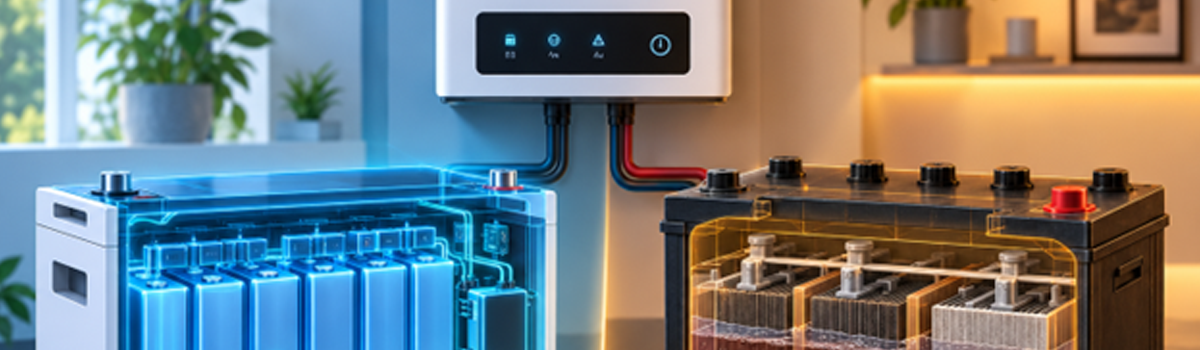
Lead acid batteries, whether flooded, tubular, or sealed maintenance free, store energy through a chemical reaction between lead plates and sulphuric acid. They are a well established technology, widely available, and familiar to most electricians and installers across India. Lithium batteries, mostly lithium iron phosphate (LFP) in inverter applications, store energy differently and pair with a battery management system that actively protects the cells and manages charging.
This is not just a price difference between two similar products. It is two different approaches to storing power, and each comes with its own set of trade offs.
Upfront Cost and Total Cost of Ownership
Lead acid batteries are cheaper to buy, often less than half the price of a lithium battery of the same backup capacity. For a buyer focused only on the purchase price, lead acid looks like the easy choice.
But the total cost over the life of the battery tells a different story. A lead acid battery typically needs replacement every three to five years, while a lithium battery can run for eight to ten years or more under normal home use. Over a ten year period, most households end up buying two or three lead acid batteries against one lithium battery, which narrows or closes the cost gap depending on usage.
Maintenance and Day to Day Use
Lead acid batteries, particularly flooded and tubular types, need regular maintenance. Water levels need to be checked and topped up periodically, and the battery area needs decent ventilation because of gas released during charging. Skipping this maintenance shortens the battery life significantly.
Lithium batteries need essentially no manual maintenance. The battery management system handles charge balancing and protection automatically, and there is no water top up or ventilation requirement in the same way. For buyers who want to install a battery and not think about it again, this is one of the clearest practical differences between the two.
Backup Time, Space, and Weight
Lithium batteries pack more energy into a smaller and lighter unit than lead acid batteries of the same backup capacity. This matters directly for homes and offices with limited space for battery storage, and it also makes installation and any future replacement easier.
Lead acid batteries are bulkier and heavier for the same backup output, and their usable capacity also drops as the battery ages faster than a lithium battery does over a comparable period. A lithium battery tends to hold its rated backup time more consistently across its life, while a lead acid battery gradually gives shorter backup as it nears replacement.
Which One Makes Sense for Your Home or Office
For a household with occasional power cuts and a tight upfront budget, a lead acid battery remains a reasonable choice, particularly tubular batteries, which offer a decent middle ground on price and life.
For a household or office with frequent power cuts, daily inverter use, limited installation space, or a preference for minimal maintenance, a lithium battery is generally the better long term choice despite the higher purchase price. The same logic applies to commercial and industrial buyers, where daily cycling and long term reliability matter more than the upfront number.
What This Means for Your Decision
A few practical points are worth keeping in mind once you have compared the two chemistries above.
Compatibility matters as much as chemistry. Most existing inverters can run a lithium battery, but full performance usually needs an inverter that supports lithium communication protocols, so it is worth checking this before replacing an old lead acid setup. Safety comes down to build quality rather than the chemistry itself. A lithium battery with a proper battery management system, sourced from a certified manufacturer, is safe for everyday home use, and the BMS is what continuously monitors voltage, current, and temperature to prevent failure. Pricing follows a simple pattern. Lithium typically costs more than double a lead acid battery of the same backup capacity at the time of purchase, though the gap narrows over the life of the battery once replacement cycles are factored in. And usage pattern should drive the final call more than the price tag alone. A household with occasional power cuts and a tight budget may still be better served by a tubular lead acid battery, while a household or office with frequent power cuts, daily inverter use, or limited installation space will usually get more value from lithium despite the higher upfront cost.
Choose the Right Inverter Battery for Your Home
There is no single right answer between lithium and lead acid, only the right answer for how a home or office actually uses its inverter. Lead acid remains a sound, budget friendly choice for occasional backup and lighter use, while lithium earns back its higher price through a longer life, lower maintenance, and steadier backup performance for anyone running their inverter hard. Match the battery to your daily usage and available space first, and the right chemistry becomes the easy part of the decision.
Enquire Now to get a battery recommendation matched to your actual usage, not just the price list.


