
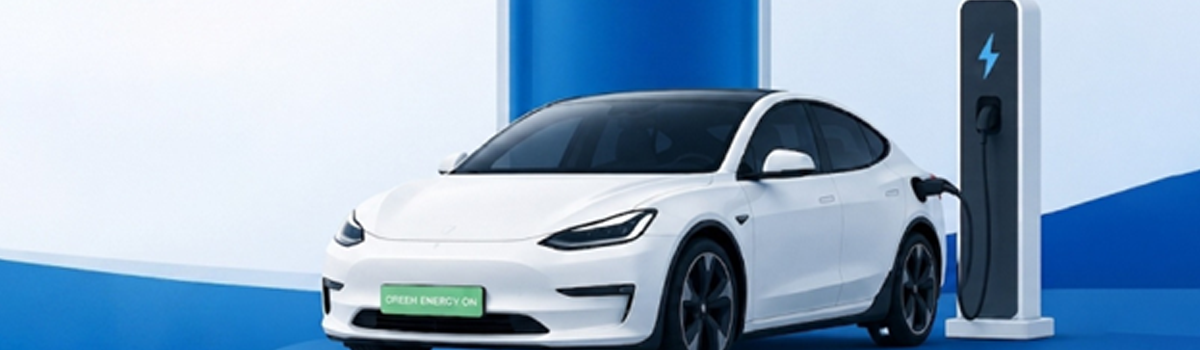
GEON works in E-Mobility and battery solutions and builds EV battery systems designed to hold their capacity well beyond typical warranty thresholds. Understanding the 80 percent rule helps owners and fleet operators get more real world life out of every pack. Enquire Now to learn more about our EV battery systems.
The 80 Percent Charging Rule for Daily Use
Lithium ion cells, the same chemistry used in almost every modern EV, degrade faster when they sit at a full charge or an empty charge for extended periods. Charging to around 80 percent for regular daily driving keeps the cells in a more moderate state of charge, which puts less stress on the internal chemistry over thousands of charge cycles.
This does not mean a full charge is harmful in isolation. Charging to 100 percent before a long trip is fine and often necessary. The concern is with habitually charging to full and then leaving the vehicle at that level for long stretches, since prolonged time at a high state of charge is what accelerates wear, not the act of reaching 100 percent itself. Most EV manufacturers build this guidance directly into their charging software, offering a daily charge limit setting alongside a separate setting for trips that need the full range.
The 80 Percent Capacity Rule for Battery Health
The second and more consequential meaning of the 80 percent rule relates to how the industry defines meaningful battery degradation. As an EV battery ages, its ability to hold a full charge gradually declines. When a battery retains 80 percent or more of its original capacity, the difference in real world range is usually small enough that most drivers do not notice it. Once capacity drops below 80 percent, the loss becomes more apparent in daily range and charging behaviour.
This is why 80 percent has become the standard reference point for EV battery warranties across most manufacturers. A typical EV battery warranty guarantees that capacity will not fall below 80 percent within a set number of years or kilometres, and if it does, the manufacturer replaces or repairs the pack under warranty. The number is not arbitrary. It reflects the point at which battery aging shifts from barely noticeable to something that meaningfully affects usable range.
What Actually Causes an EV Battery to Degrade
A handful of factors drive most of the capacity loss an EV battery experiences over its life, and awareness of these helps explain why the 80 percent threshold matters as much as it does.
Frequent fast charging generates more heat and places more stress on the cells than slower AC charging, so relying on fast chargers for most daily charging accelerates wear compared to overnight home charging. High ambient temperature also plays a significant role, since battery packs age faster in consistently hot climates unless they have strong thermal management built in, which is a real consideration for Indian conditions. Extended time at a very high or very low state of charge, as covered above, is another major factor, and total distance driven and total charge cycles completed naturally add up over the life of the vehicle as well, since every battery has a finite number of full charge cycles built into its design life.
Why This Matters for EV Owners and Fleet Buyers
For an individual EV owner, understanding the 80 percent rule means adjusting a simple daily habit, setting a charge limit around 80 percent for routine use and reserving full charges for longer trips, which can meaningfully extend how long the battery performs close to its original capacity.
For fleet operators and commercial EV buyers, the 80 percent capacity threshold is directly tied to total cost of ownership. A fleet vehicle that holds capacity above 80 percent for longer delays the point at which range becomes a problem for daily routes, which affects everything from route planning to resale value. This makes the battery management system, thermal design, and cell quality of the vehicle just as important a purchase consideration as the sticker price or the advertised range, since these are the factors that determine how quickly a pack approaches that 80 percent line.
What This Means in Practice
A few practical takeaways follow directly from the two meanings of the 80 percent rule. Setting a daily charge limit around 80 percent, where the vehicle software allows it, is a simple habit that reduces long term battery stress without meaningfully affecting day to day usability. Full charges remain appropriate before long trips and should not be avoided out of excessive caution. Warranty terms should always be read with the 80 percent capacity threshold in mind, since this is the number that determines when a manufacturer is obligated to act, not a general promise of like new performance for the full warranty period. And for anyone buying an EV or a fleet of EVs, asking directly about battery management system design and thermal protection is a more useful question than asking about range alone, since these are what determine how long a pack stays above the 80 percent line in real world conditions.
Get More Life Out of Every Charge
The 80 percent rule for EV batteries is really two related ideas working together, a daily charging habit that reduces stress on the cells, and an industry benchmark that defines when a battery has aged enough to matter. Understanding both helps owners charge smarter and helps fleet buyers evaluate a vehicle on more than just its advertised range. The batteries that hold up best over time are the ones engineered with strong thermal management and a properly designed battery management system from the start.
Enquire Now to see how GEON engineers EV battery systems for longer real world life.