
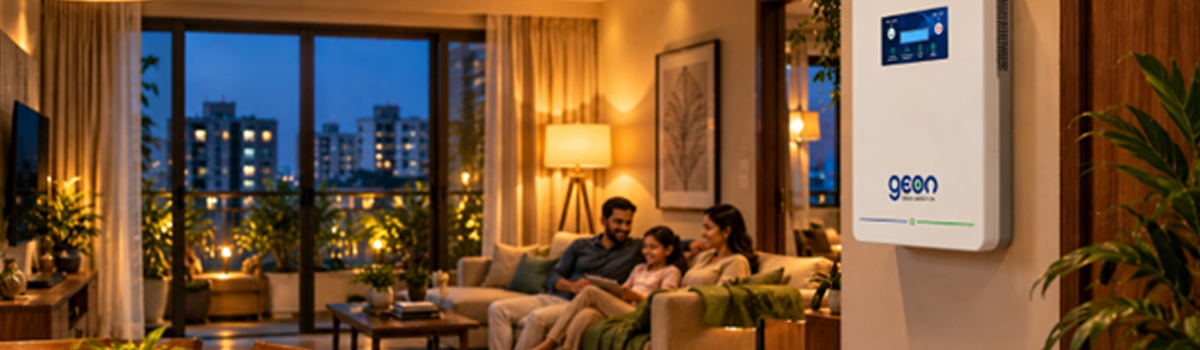
An integrated inverter combines the inverter and the battery into one matched unit, so you buy, install and service a single system. It is usually simpler, more compact and better coordinated than a traditional setup. A separate inverter and battery gives you more freedom to upgrade each part on its own.
GEON offers integrated inverter solutions for homes and businesses across India.
Two ways to build home backup
The traditional way. An inverter, a separate battery (often lead acid), cables and a trolley or rack. You can mix brands and replace the battery alone, but voltage, capacity and charging settings need to be matched correctly.
The integrated way. Inverter, battery and control electronics are designed together as one system. The battery management system and the inverter talk to each other, so charging, protection and display are coordinated instead of guessed.
How long would your home actually run?
Here is a worked example so you can picture it. Say you want four LED lights, three ceiling fans, a Wi-Fi router, a television and a laptop running during a power cut. That adds up to roughly 445 watts.
On a 2 kWh battery, using about 80 percent of its rated capacity after conversion losses, that is around three and a half hours of backup. Add a refrigerator and the time drops. Add an air conditioner or a geyser and it drops very fast, which is why those heavy loads are usually left off a home battery.
Real backup depends on the product, its inverter rating and appliance start up surges, so treat this as a feel for the maths, not a promise. Ask your supplier for backup time based on your own list of appliances.
What you gain
- Components designed to work together
- Simpler installation with fewer cables
- A compact footprint, good for tight spaces
- Clear status display on many units
- One warranty and one team to call
- Built in battery management protection against overcharge and overheating
What you give up
- Less freedom to mix and match batteries
- A higher upfront cost than a basic lead acid setup in many cases
- Service that depends on a single brand
- Capacity that may be fixed by the design
Integrated vs separate at a glance
Installation. Separate means matching and connecting parts. Integrated is plug and play.
Space. Separate is bulkier. Integrated is compact.
Upgrades. With a separate setup you can replace the battery alone. Integrated is usually replaced or serviced as a system.
Upkeep. Lead acid needs periodic checks. Lithium based integrated units need very little.
Support. Separate may mean two vendors. Integrated gives you one point of contact.
Who should consider an integrated inverter
It is a good fit for homes and offices short on space, buyers who want a low maintenance single brand solution, households with frequent power cuts and daily inverter use, and anyone setting up a new backup system.
A separate setup may suit buyers who already own a working inverter and only need a new battery, those on a tight upfront budget, or anyone who wants to choose each component independently.
Before you buy
- Know the backup time for your actual load, not a brochure load
- Know the battery chemistry and its warranty
- Check that the inverter rating covers your essential appliances
- Confirm service is available in your city
- Ask whether it supports solar input, if you might want that later
Frequently Asked Questions
What is an integrated inverter?
An integrated inverter combines the inverter and the battery in one matched system, designed to work together with coordinated charging and protection.
Is an integrated inverter better than a normal inverter?
It is better for simplicity, compactness and low maintenance. A normal setup is better when you want to reuse existing equipment or pick each component yourself.
Does an integrated inverter use a lithium battery?
Many do, because lithium suits compact designs and low maintenance. Check the product specifications for the exact battery type.
Can an integrated inverter run my whole home?
That depends on its power rating and battery capacity. Most home units are sized for essential loads such as lights, fans, a router and a television.
Does an integrated inverter need maintenance?
Lithium based integrated systems need very little routine care compared with traditional lead acid batteries, which need regular water and terminal checks.
Can I connect solar panels to an integrated inverter?
Only if the model supports solar input. Confirm compatibility with your supplier before you buy.
Related reading: Signs Your Inverter Battery Needs Replacement
Related reading: Solar Panels With Battery Storage
Make power backup simple
An integrated inverter takes the guesswork out of matching an inverter to a battery. Choose it for convenience and coordinated performance, or go separate for flexibility and budget.
Ready to find the right fit? Call GEON on +91-022-6735 3333, email info@geon-energy.com, or visit us at Fortune Terraces, 10th Floor, B Wing, Opp. Citi Mall, Link Road, Andheri (West), Mumbai 400053.